
Community & Communitas
Third Space Resistance

Saying it has been a week might be an understatement. The season's first snowstorm hit just as election results came rushing in. I think I’ll never forgive the NYT for their prediction meter that felt a little too much like a temperature check in a car than, well, the next four years. I keep thinking about the end of Taylor Swift’s Eras tour coinciding with what historians will call the Trump Era of American politics. In the fairytale of my imagination, the choice was between a Trump Era and a Taylor Era—somehow we live through both.
Last night, I hit my head in the laundry room on a shelf I installed a few weeks ago. The shelf survived just fine, and I thought—what better time to sustain a head injury? (Don’t worry mom. I’m fine). But still. I thought—what a great time to get in bed, say for a year, maybe 20 a la Rip Van Winkle, and wake up in a “free world”.
This morning, with my splitting headache and perhaps the same clumsiness that landed me in this situation, I broke the Brita filter. (Don’t worry Mom, my kitchen floor is real clean now.)
At Costco, trying to balance too many things: a Brita, saline spray, hydrogen peroxide, and a 12lb box of Epsom salts, a woman asked “Are you okay, would you like me to tuck that box under your arm?” My hands so full, I kicked the box across the cement floor. “No,” I replied, “the line is just moving faster than I expected.”
The line is just moving faster than I expected.
This week, I’m supposed to teach about Jenny Odell’s third space from How To Do Nothing, Resisting the Attention Economy. One example of someone occupying third space she uses is Thoreau. Any mention of Thoreau these days makes me think of John Mulaney’s portrayal of the insufferable naturalist on Apple TV’s Dickinson.
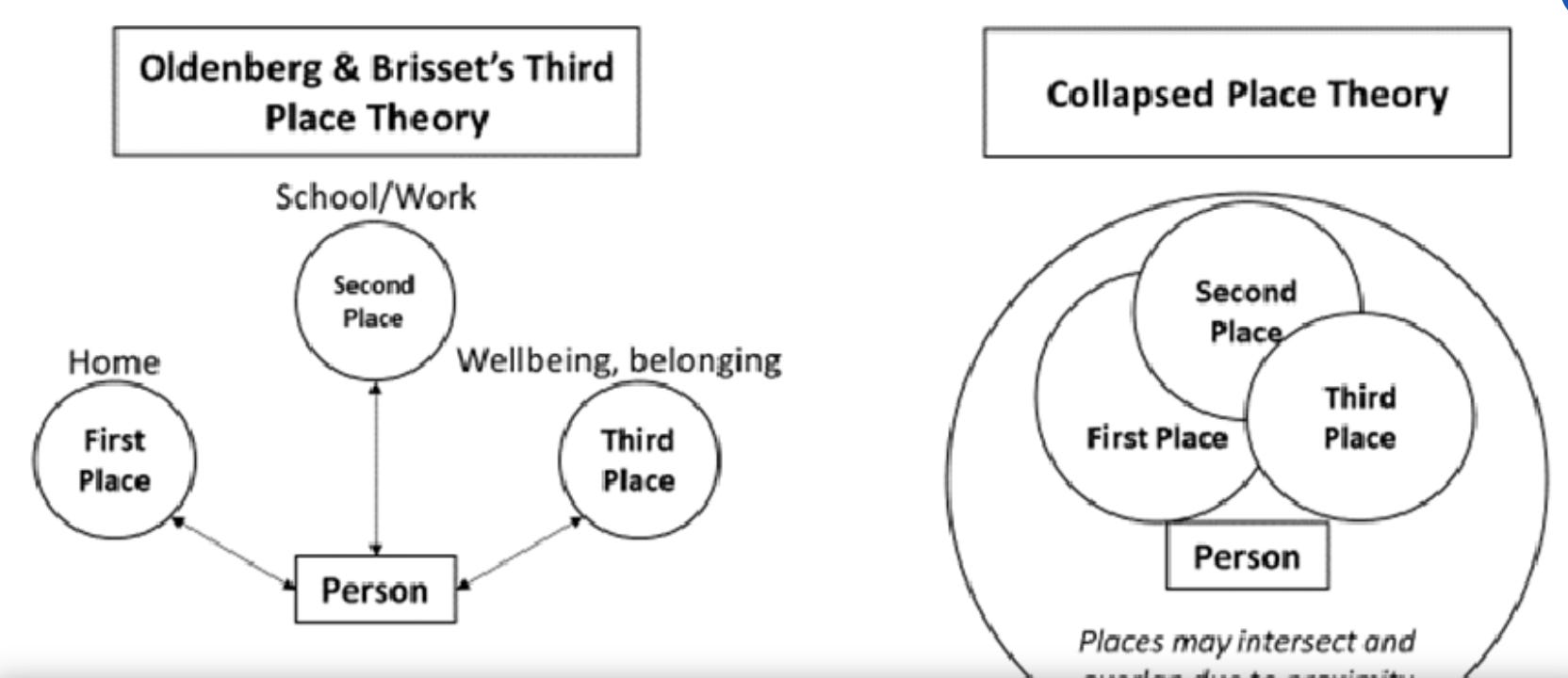
Third space comes from the idea that we occupy 3 spaces: home, work/school, and a third place of social belonging. In Odell’s work, this third space becomes a place of social resistance as someone continues to live in society. But instead of belonging, several of the examples are rooted in isolation, as if the only way to resist the system is to disengage entirely. But can this create social change?
This weekend CNN proposed the popular sex strike of South Korea’s B4 movement was headed to the US now that it’s clear “men hate women.” I think with any nuance and understanding of US history, our white supremacist misogyny is so embedded, a true sex strike is unlikely.
Why, you might as can we not engage in refusal like the ladies of Lysistrata and their younger cousins, the women of Loves Labours Lost? Because our idea of occupying third space is one of isolation.
There’s been a lot of discussion in undergrad classes this month on the internet as a place for connection that also breeds a feedback loop that one can become trapped in. This is a different kind of third space aimed at isolation in order to create a social movement. The disembodied space of the internet creates a portal not often to new information but instead to a hall of mirrors creating the same narrative over and over again until someone believes it is real.
The tragedy of the internet is both the ease at which we can learn things and the degree to which it removes our knowledge from other bodies. The chat room that once created a third space for those in need of community has in the Taylor and Trump Era distorted. Fake news. Deepfakes. Forgetting we live in bodies next to other bodies because for so long we weren’t allowed to touch.
In their work on Communitas, anthropologists Victor and Edith Turner looked at collective ritual acts as a necessary anti-structure for the community to inhabit—a third space for healing.
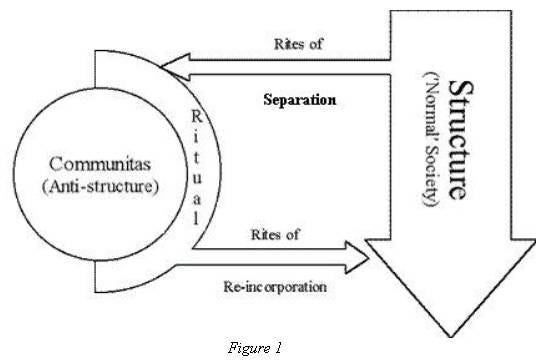
In this type of third space, folks collectively leave structured society, turn the world upside down and then after the ritual is over, they integrate back into society. The thing about ritual is that no matter what, people change (whether they realize it or not).
When I think about turning the world upside down, I often think about the horror franchise The Purge as an example of a brief breaking of social structure. In late capitalism based on survival, societal rules, and the breeding of hate for no reason—this is of course the kind of anti-structure our imaginations produce: isolate, fear, murder, and enough adrenaline for at least half a dozen films that allow folks to live vicariously through the rule-breaking of others, no questions asked, no shame required.
Carnival fits the classic structure of communitas, but so does the solidarity of the women in Loves Labours and Lysistrata, occupying third space together in order to upend the status quo.
On Friday, I watched Brian Jordan Alvarez’s new Hulu series, The English Teacher, which follows Alvarez’s character, Evan, a gay, 35-year-old high school English teacher in Austin.
In the episode about powder puff football, the queer coalition brings up that powder puff is outdated and offensive to the queer community because it mocks identity. Evan convinces them that drag is as queer as it gets and the kids agree, that if powder puff is taken seriously, it won’t be offensive. Evan hires a queen to coach the boy’s football team (played by Trixie Mattel) in a routine that is not imitation or mockery of the cheerleaders or women, but true performance.
As Alvarez’s character manages the boys learning about silicone breastplates and tucking, the girls practice flag football with Gwen, Evan’s best friend who teaches something, but it’s never quite clear what. The bumbling and often inappropriate coach Markie attempts to teach Gwen about football, but instead the team uses true crime podcasts to teach Markie about what it means to be a woman in America.
The series juxtaposes dance training in heels with the girls practicing self-defense on the field, Gwen teaching Markie all the ways he could die by not keeping his keys between his knuckles like Wolverine claws when he walks to his car at night. The genius of this episode is that the powder puff tradition (while steeped in gender stereotypes) is an occupation of third space—it is a communitas ritual. Here, however, instead of creating a narrative centered on football and farce, it centers on going all out (rather than marking in) in a way that truly explains the power of turning the world upside down.
It is only in this gender-bending, this communitas that all the powder puff students step into their power as queens and self-defense mavens, refreshing the antiquated tradition with a real take on what it means to be a young woman or a queen in America.
I think now is the time to cultivate third space. Create coalitions. Rest. Isolation is only okay if you’re Thoreau with an arrogant chinstrap beard. For the rest of us, may the third space be fierce, may we not mark it, may it make some noise.